

Shadows of Summer
Anna stages a participatory performance recreating the abuse she suffered at a theater camp.
Thirty-year-old actress Anna stages a participatory play about the summer she spent at theatre camp 16 years ago, locking the audience inside the hall. Among them are her estranged father, her former bully Maria, and Peter, the charismatic instructor who abused 14-year-old Anna.
As the performance unfolds, Anna’s memories return: lonely and isolated, her only comfort was Peter, a 25-year-old instructor who used his authority to manipulate her. Over time, Anna realizes Maria wasn’t just an enemy, but another girl Peter had broken before her.
The immersive play soon transforms into a public trial.
Producers' note
"Shadows of Summer" came to Nafta Films in 2024, when director Helen Takkin presented us with a treatment inspired by her personal experiences. We immediately felt that the story explores highly relevant and important themes, including power dynamics, the exploitation of a minor by an adult, bullying, and codependency. The narrative unfolds across two timelines — a present-day participatory theatre performance and the events of a summer sixteen years earlier — which gradually begin to merge with one another and with the theatrical world itself, giving the script's universal themes a distinctive and original cinematic form.
To date, “Shadows of Summer” has received both Script Development and Feature Film Development funding from the Estonian Film Institute and the Cultural Endowment of Estonia.
Most of the story takes place at a youth camp in a forest by the sea, while the present-day storyline unfolds in a black box theatre. This gives us considerable flexibility in terms of locations, as the story could be filmed almost anywhere. We have also begun the casting process.
We believe this project addresses urgent issues that deserve to be discussed by both young people and adults. Although the story is fictional, these issues unfortunately continue to emerge in the media today. We believe the film has the potential to spark meaningful conversations around these themes while also offering comfort to those who have lived through similar experiences.
Our main focus at the co-production market is to find co-producers who share our vision and help bring this project to life.
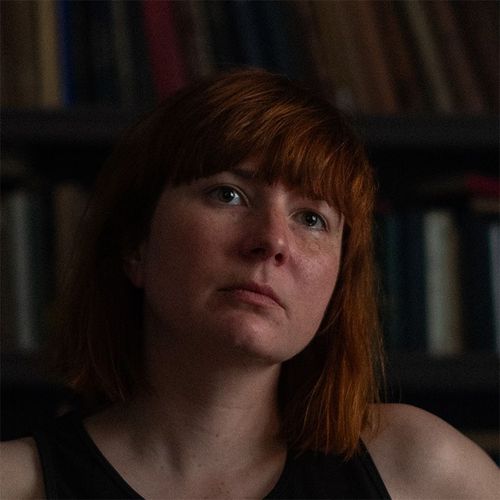
Director's note
As a teenager, I didn’t fit in, and attention from older men felt like warmth at a time when I had little of it elsewhere. I didn’t understand the imbalance of those relationships; I only felt wanted. Later, I realised how often I disappeared inside them, blamed myself for things that were never my responsibility, and carried guilt for speaking about what was happening. Those experiences taught me to read moods, adapt myself, and mistake emotional labour for love.
The film grows from that. The story is fictional; the feeling underneath it is not. Anna believes her participatory performance will bring clarity, but she creates a new harm, imposing her version of events on people who can't fully defend themselves. She locks the doors and casts the audience as the people from her past. Among them sits Peter, the man who groomed her there as a teenager, brought in as a guest without knowing what's waiting. No one in the room is only watching. Spectatorship is one of the film's subjects: what do we do when we sense something is wrong but don't know whether, or how, to intervene?
The story unfolds between two worlds. The past is a summer, summoned back by light, sound and rhythm: intimate, warm, instinctive. The present is a controlled theatre, cool and dry and acoustically bare, where that control slowly unravels until the two timelines merge. Because the film keeps you unsure what's real, the image is the one thing you can trust. Shadows carry the film's meaning. In the summer they conceal, reveal, blur bodies; in the theatre, nothing is allowed to hide, but the darkness cradles them.
The film distrusts good intentions, including its own. Anna is sure she's doing the right thing, and the film refuses to let her motive excuse the cost. There is no clean verdict here and no absolution. Peter walks out untouched, and no one is healed. What remains is the confusion, the contradiction, and the lasting weight of people carrying different truths about the same harm.
Biography
Helen Takkin (1988) is a director and editor who studied audiovisual media at the Baltic Film, Media and Arts School in 2007–2011. She has worked in production companies NAFTA Films (2011–2013) and FrostFX (2013–2014). Since 2014, Helen has worked as a freelance commercial film director both in Estonia and abroad. In 2024, she made a debut with the full-length feature film “Life & Love” based on the novel of the same title by A. H. Tammsaare.
Filmography
Elu ja armastus (2024)

Biography
Andreas Kask joined Nafta Films in 2014 and has since worked as a Producer, Associate Producer and Co-Producer on several productions. For the past four years he has been the Head of Development in the company's film department, overseeing the creative process of all of Nafta's feature films, short films and co-productions.

Profile
Founded in 2009, Nafta Films quickly became one of the largest production companies in the Baltic region, producing audiovisual content in various forms: films, TV productions, and commercials.
Nafta Films is the only production company with offices in all three Baltic countries and access to a network of hundreds of creative professionals in Northern Europe and the Baltic states, with whom they collaborate on a project-by-project basis.
Currently, Nafta Films is working on 18 projects, each at various stages of development and production.