
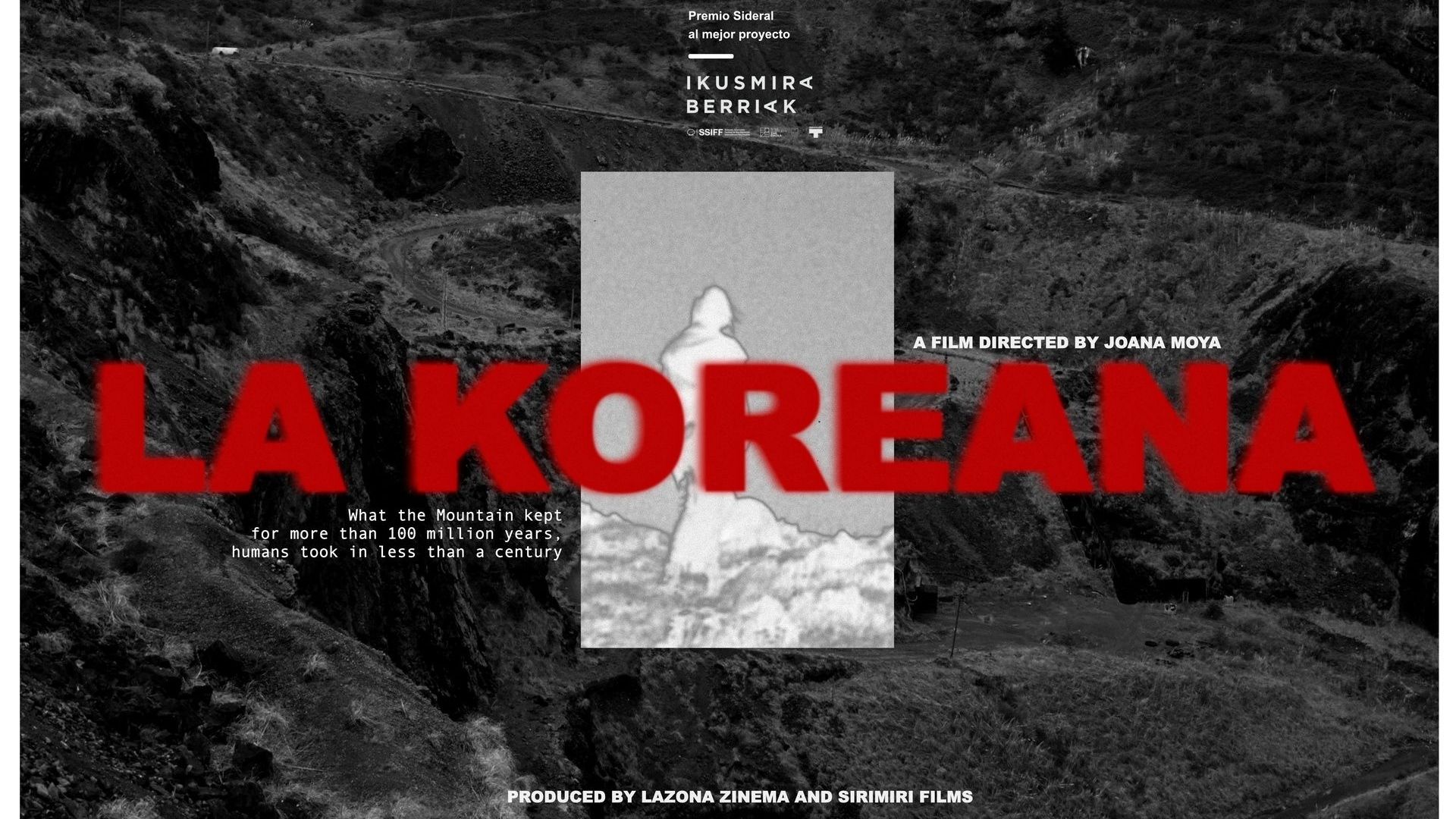
La Koreana
What the Mountain kept for more than 100 million years, humans took in less than a century.
The story unfolds across three periods – 1890, 1960 and 2026 – linked by a Mountain shaped by iron mining and memory. In 2026, Haran, a young speleologist, descends into its depths after hearing an ancient sound. In 1890, miners led by Tasio endure exploitation, illness and hardship while collective resistance begins to emerge. In 1960, Manuela ("la Koreana") arrives from Andalusia and struggles to adapt to a landscape scarred by extraction, finding her own voice as the mining village faces demolition. When the Mountain finally splits open, villagers are drawn into its depths. Decades later, Haran uncovers the traces of those lives buried beneath a transformed landscape.
Producers' note
Joana had laid the foundations for a project that combined several elements that interested us: La Arboleda, a fascinating setting full of historical memory located in the Bizkaia mining region; a historicist yearning combined with a distinct auteur perspective, where the atmosphere immerses us in the time of eternal return, and the attentive, curious, incorruptible perspective of someone with Joana's unique profile: film director, geologist and dancer.
The historical, economic and cultural legacy of our present can be sensed in this story fragmented across three timelines. La Koreana explores how the concept of the workforce has been determined over time and, specifically, how it has been expressed between men and women throughout history; it observes the extractivist relationship between human beings and nature and reflects on the class struggle and worker solidarity; it portrays the cultural and linguistic exchange between thousands of workers from all over Spain, as well as the transition of the culture itself in its forced opening up to otherness in the context of an industrialisation that has been perhaps too idealised.
Trapped by the Mountain's magnetism, we joined the production team of La Koreana. After a fruitful phase of development that has led the project to be selected for numerous prestigious programmes and spaces (notably the Ikusmira Berriak residency, which concluded with the SIDERAL award for the year's best project at the Co-Production Forum of the San Sebastian Film Festival), we are now facing the decisive financing phase and joining forces between Sirimiri Films and LAZONA Zinema in a crucial and momentous commitment for both production companies based on collaboration and the conviction that we are supporting a proposal that is as radical as it is exciting, a bold look at the blind spots in our recent history, a cinematic work impossible to ignore.
We invite you to climb inside the mountain with us.
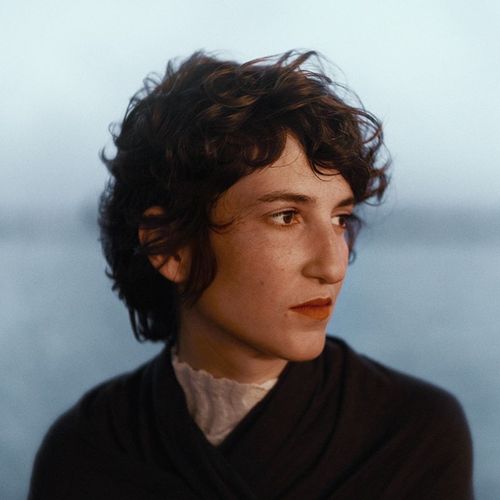
Director's note
La Koreana is a film that emerged from the intersection of personal and geological memory, between bodies that resist and rocks that remember. Set in a mining mountain in the Basque Country, the film interlinks three eras and multiple languages – historical, visual, sound and physical – to explore how the extraction of land and work shaped not only the landscape but also how we remember and inhabit the past.
Far from adopting a historicist approach, La Koreana proposes a living narrative in transformation, where the mountain is not a backdrop but rather a presence that watches over, that speaks, that demands to be heard. The film will use evocative, poetic language in which image and narrative pace take on central importance, prioritising visual emotion and the symbolic over words.
La Koreana will use a dual approach to photography, depending on the era portrayed. The historical blocks – 1890 and 1960 – will be filmed in black and white by Michal Babinec, whose unique perspective will help intensify that tension between the tangible and the enigmatic. The prologue and epilogue, which take place in 2026, will be filmed in colour in a 16:9 format in a more exploratory approach led by Cris Neira, whose perspective aims to record the land from a physically close, attentive standpoint.
Although La Koreana is a work of fiction, the entire film is interspersed with archival footage, inserting historical fragments of blue-collar Bilbao. In addition to showing this land’s past – which no longer exists – the intention is to blur the lines between reality and fiction, between past and present, allowing the narrative to be open to multiple interpretations.
Inspired by my grandmother’s personal story, the film poses a central question: How does memory – both individual and collective – not only rewrite the past but also condition the future?
Screenwriter's note
The project originated from a diary written by my grandmother, who moved in 1959, at the age of eighteen, from her native Málaga to La Arboleda (Bizkaia), a mining settlement where her husband had been working. In vivid, poetic language, she described the train journey across Spain and the gradual transformation of the landscape that announced the life awaiting her.
What she found upon arrival was a world radically different from anything she had imagined: a mountain scarred by mining activity, wrapped in constant fog and shaken by daily explosions. This hostile and unfamiliar environment left her feeling displaced and suspended in a kind of limbo.
When researching the historical context of mining in Bizkaia (late 19th century to mid-20th century), I was surprised by how profoundly these mines transformed the region’s landscape, work and society. From the end of the 19th century, La Arboleda became a social microcosm. Iron attracted people from all over Spain, known by locals as “los Koreanos” (the Koreans). They arrived with their own beliefs and hopes, but the difficult working conditions and poverty they faced forged a solid class consciousness, which culminated in the workers’ strike of 1890. When mining operations ceased, La Arboleda was dismantled and forgotten.
This research led me to the idea of developing the script like an excavation. As the miners bore into the mountain in search of iron, the film penetrates its temporal layers, progressively descending into its depths. The story begins on the surface in today’s landscape in 2026. Through a cavity in the mountain, we travel to other eras – 1890 and 1960 – where the narrative core of the film takes place: the human drama and the drama of nature are interwoven through a crew of miners, the character of La Koreana and the Mountain itself.
Biography
Joana Moya (Bilbao, 1985) is a filmmaker with a background in geology and contemporary dance. In 2022, she directed and produced her debut short, Salt Covers It All, which screened at major international festivals, was shortlisted for the 2025 Goya Awards, and was acquired by EITB, Instituto Cervantes and ICAA for distribution. She is currently producing her first feature film, La Koreana, selected for Ikusmira Berriak 2025, where it received the SIDERAL Award for best project.
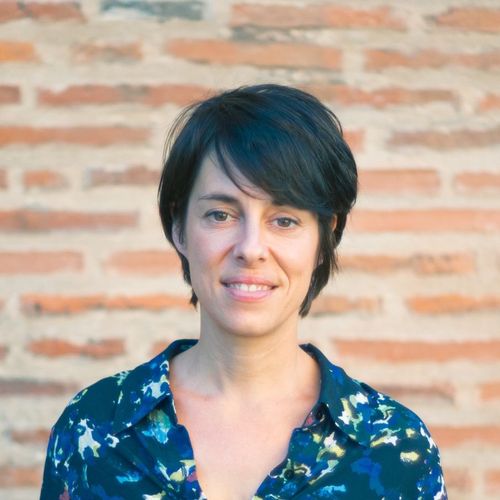
Biography
With degrees in Audiovisual Communication (UPV/EHU) and Editing Theory (EICTV Cuba), and master’s degrees in Film Direction (ESCAC), she founded SIRIMIRI FILMS. Her short Cuerdas premiered at Cannes Critics’ Week in 2022, winning a Forqué Award and earning a Goya nom. Her debut feature, 20,000 Species of Bees, won the Berlinale Silver Bear for Best Leading Performance and the Goya Awards for Best Original Screenplay and Best New Director. She is currently co-producing El Canal de la Mancha.
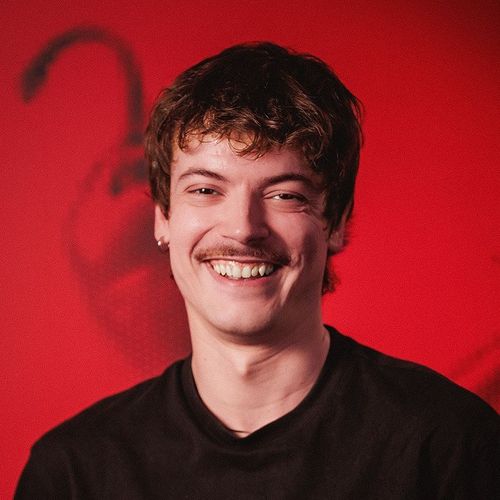
Biography
Trained in film production at ECAM, he began producing shorts in 2021, earning recognition at worldwide festivals. Selected for Málaga Talent in 2022, he joined Buenapinta Media, working as delegate producer on features such as Sundays, Sleepless City and Tre Ciotole. He has also coordinated post-production and awards campaigns for HBO Max, Netflix and Disney+. Named one of Variety’s 10 Emerging Spanish Producers to Watch in 2024, he joined LAZONA Zinema as managing executive producer in 2025.
Profile
LAZONA Zinema is a division of the long-established and award-winning LAZONA group, based in the Basque Country and created to develop an independent production line that combines bold projects from emerging Basque voices with large-scale productions and international co-productions.