
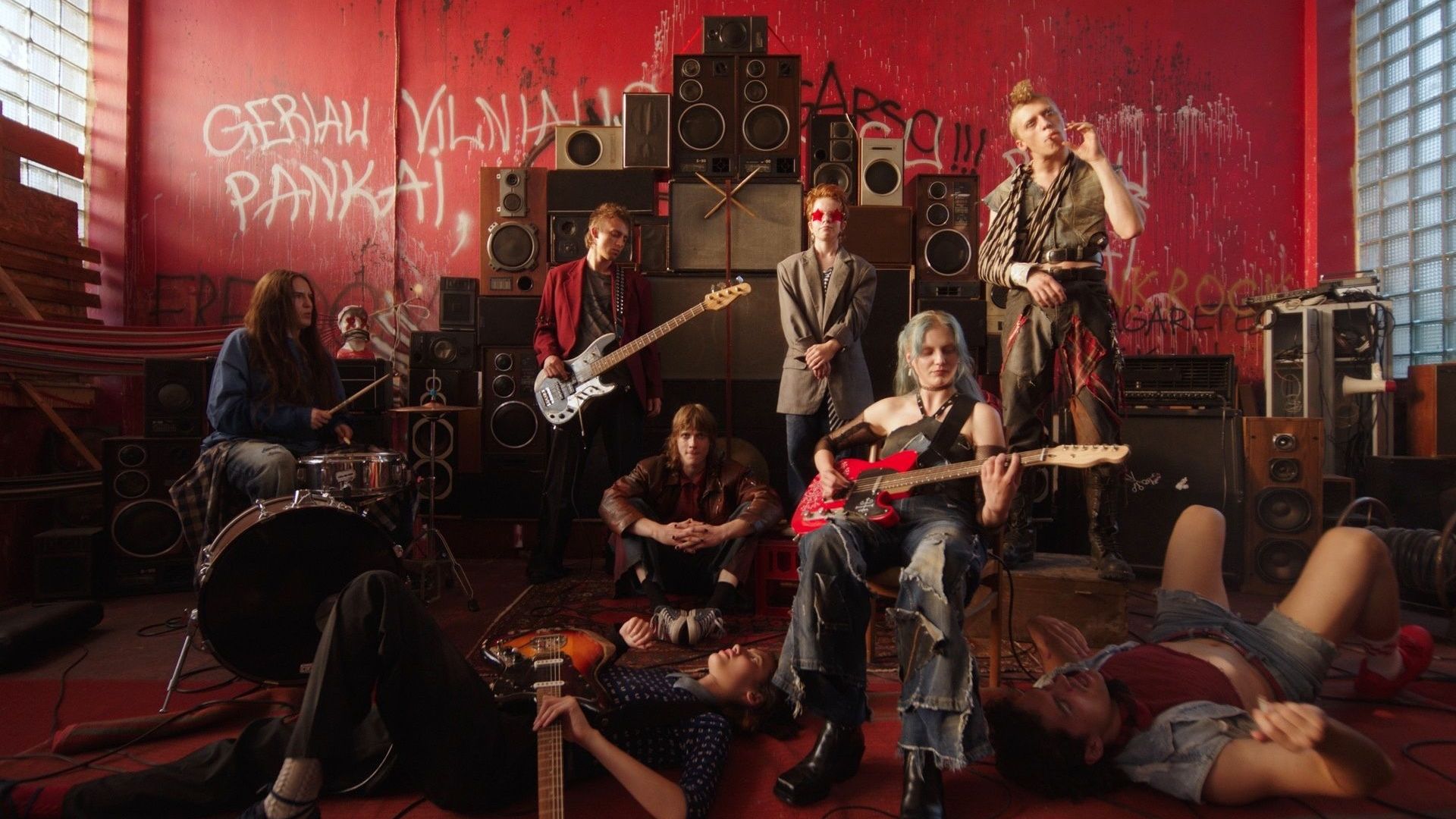
Concrete music
Musically gifted teenager Rokas flees his mafia family to avenge his mother's death through music.
Vilnius, 1997. Teenager Rokas sits in a courtroom where a criminal case of national importance is being tried. The city is controlled by the mafia, while the police are powerless. Rokas lives in a wealthy mafia family. His father forces him to attend martial arts classes, but Rokas discovers the school choir, where his musical talent flourishes. He has absolute pitch, a unique voice and masterful piano skills, but his father has other plans. He heads the dangerous ‘Local' mafia group, while Rokas's brother Andriocha is a member. Rokas meets alternative youths who have formed a rock band and seem to have what he lacks: the freedom to sing.

Director's note
I still remember what it was like to grow up in 1990s Lithuania. Violence, organised crime and fear were part of daily life. I was six when my mother left, and music became my only way to escape a world of burning garages, street gangs and constant tension. As a teenager, I turned to music not for rebellion, but for survival, while freedom around me was interpreted through crime, underground youth culture or silence. Concrete Music is my personal essay about a generation raised during independence, forced to grow up too fast. Through Rokas's journey, I ask the question that still defines us: which version of freedom do we choose, and what responsibility does it demand?
Biography
Saulius Baradinskas is an award-winning Lithuanian film director and screenwriter, recently completed his MFA in Directing at the American Film Institute Conservatory in Los Angeles. His short films have premiered at prestigious film festivals, including the Venice Film Festival, and have received nomination from the European Film Academy. In 2026, he is set to direct his feature musical film, Concrete Music. With a distinctive voice that blends magical realism and deeply personal storytelling, Saulius continues to create experimental dramas and expand his career across both Hollywood and European cinema.

Biography
Eglė Vertelytė (1983) is a Lithuanian screenwriter and director. After gaining a BA in History from Vilnius University, she continued her studies at the European Film College in Denmark and gained an MA in Screenwriting at the National Film and Television School in England. In 2009 she moved to Mongolia where she filmed her first mid-length documentary “Ub Lama” (2011) which received six international awards and was screened in over 20 international festivals. 2017 feature film “Miracle” premiered at Toronto International Film Festival, screened in more than 50 festivals worldwide (including six A-class film festivals) and won the Silver Crane Award, the most prestigious Lithuanian film award, for the best film, best director, best writer, and best actress. As a screenwriter, she has written three feature films and ten short films. She has also taught screenwriting at the Lithuanian Academy of Music and Theatre.

Producer's note
Concrete Music is a raw, magical and emotionally charged musical drama about a teenager, Rokas, navigating grief, identity and rebellion in newly independent Lithuania. It is a film about a group of weirdos fighting for freedom from violence through music. The film fuses punk spirit with classical choral beauty and stylised musical numbers, offering an authentic lens into 1990s Lithuania.
With this film, we want to show that freedom is a basic human right and need. Each of us must be free to make choices about our lives, develop our potential as human beings and live a life free from fear, harassment or discrimination. I am sure the theme of freedom is universal and extremely important to all European countries today, as war is taking place in the heart of our continent.
Biography
Viktorija Seniut-Strolienė graduated from the Lithuanian Academy of Music and Theatre in 2016 with a degree in Film production. Same year, Viktorija established a film production company called Viktoria Films. Films produced by the company were selected to Semaine de la Critique, La Biennale di Venezia, International FF Rotterdam, BFI London and other film festivals.
In addition to producing, Viktorija works as a freelance line producer and production manager on Lithuanian and foreign projects.